

Skip to the main content.
Panzura-Icon-FullColor-RGB@0.75x

Panzura

Our enterprise data success framework allows enterprises to build extraordinary hybrid cloud file and data systems.

architecture-icon

Platforms

Complementary file and data platforms that deliver complete visibility, control, resilience, and immediacy to organizations worldwide.

Layer_1-1

Resources

Find insights, news, whitepapers, webinars, and solutions in our resource center.

Layer_1-2

Company

We bring command and control, resiliency, and immediacy to the world’s unstructured data. We make it visible, safeguard it against damage, and deliver it instantly to people, workloads, and processes, no matter where they are.

11 min read

Panzura Named as a Sample Vendor in the Gartner® Hype Cycle™ for Storage Technologies, 2026

Panzura Named as a Sample Vendor in the Gartner® Hype Cycle™ for Storage Technologies, 2026

Table of Contents

Panzura Named as a Sample Vendor in the Gartner® Hype Cycle™ for Storage Technologies, 2026
22:25

Why Agentic AI Puts Unstructured File Data at the Center of Storage Strategy, and What to Ask of a File Platform

Key Takeaways:

  • Hybrid cloud storage has become an essential architectural foundation for unifying on-premises, edge, and public cloud environments, providing the metadata management, elasticity, and data mobility required to seamlessly support distributed AI pipelines and expanding unstructured data estates.
  • Agentic AI introduces new demands for enterprise storage by actively reading, writing, and modifying shared unstructured data, making real-time global file locking and active cyberstorage defense critical.
  • Platform consolidation through solutions like Panzura CloudFS and Panzura Nexus eliminates fragmented data lakes, providing governed, zero-copy access and near-real-time permission propagation for tools like Microsoft 365 Copilot.

Panzura has been named as a Sample Vendor in the Gartner® Hype Cycle™ for Storage Technologies, 2026 [1]. As Gartner notes, “This research assesses the business impact, maturity level and adoption speed of innovative storage technologies. Heads of I&O can use these insights to engineer resilient, future-ready storage architectures that balance high-performance delivery with shifting business objectives.”

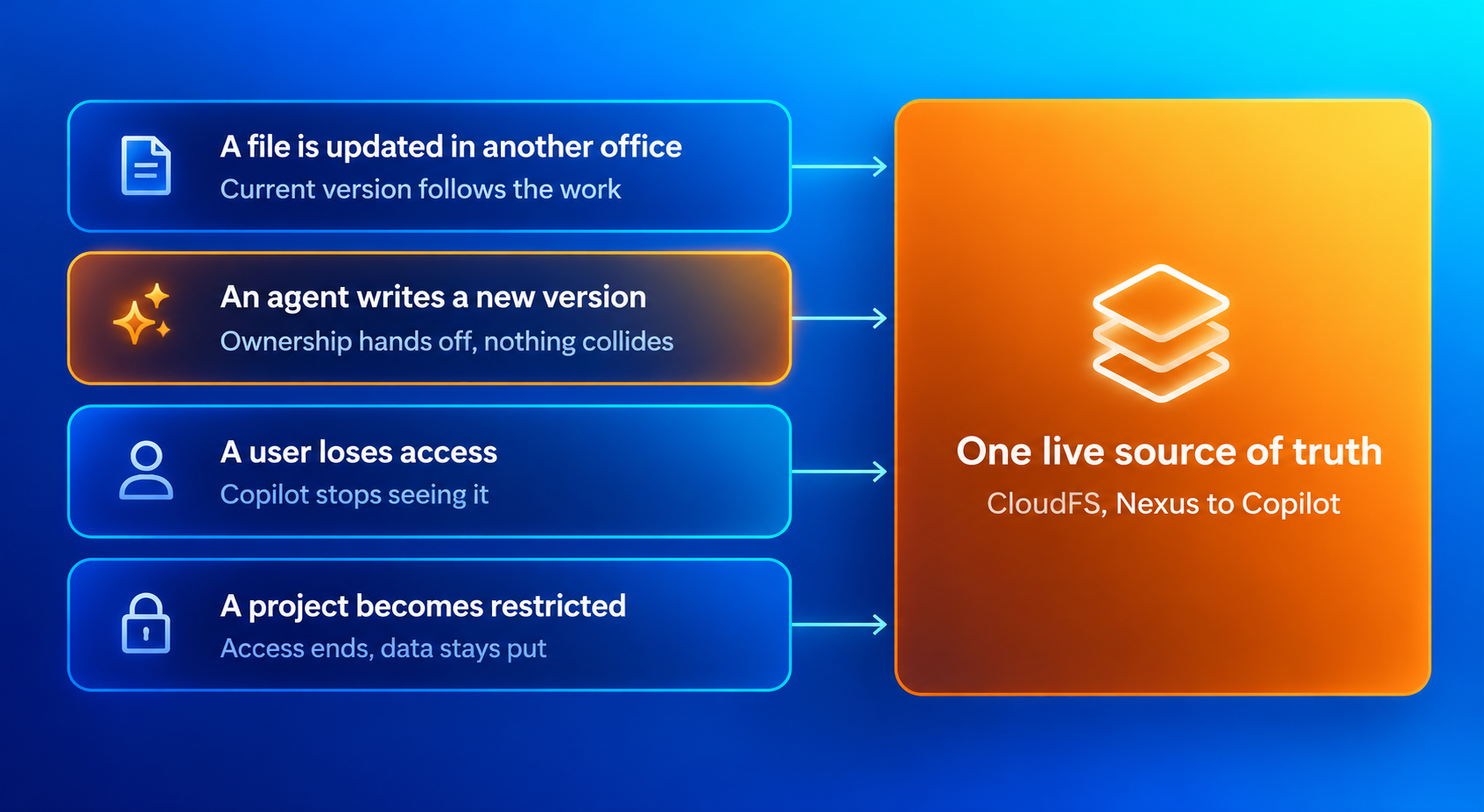
In our view, the practical question for infrastructure leaders is how a hybrid cloud platform performs when enterprise workloads change. A file is updated in another office, an agent writes a new version, a user loses access, or a project becomes subject to a geographic restriction. A feature list does not explain how the platform handles those transitions.

Gartner explains why the category matters, saying “Hybrid cloud storage is essential because it unifies on-premises, edge, and public cloud environments into a seamless data services layer. As data grows and AI workloads expand, organizations need data mobility, elasticity, and performance across locations. Hybrid models provide this agility while reducing lock-in and improving resilience for modern distributed data needs.”

Panzura’s position is that AI readiness depends on getting those underlying file operations right. The objective is not simply to make more data searchable, but rather to make current, authorized data available to the users, applications, and AI systems that are doing the work.

Why Agentic AI Changes the Storage Conversation

Gartner states in the report, “Concurrently, departments face challenges such as limited access to deep storage expertise, the support of new workload types and the requirement for more robust cybersecurity. The growing requirement to support agentic AI workloads further complicates these needs, as storage systems must now handle more diverse data flows and varied unstructured data lakes.”

Gartner also observes, “Some of the innovations focused on cybersecurity, integrated data intelligence and supporting new workloads, such as agentic AI, while mature, distributed file systems and object storage remain relevant, as AI workloads build upon unstructured data deployment.”

We believe these observations put the existing file estate squarely in the AI infrastructure conversation. For engineering, research, project delivery, and document-intensive workflows, valuable business context lives in engineering drawings, contracts, research datasets, project folders, and media files, and it is spread across offices, clouds, and archives.

Panzura sees agentic workflows increasing the importance of three established requirements:

  1. Reach: Access to relevant data across the estate, within identity and geographic restrictions.
  2. Consistency: Coordinated access when supported applications, users, and automated processes work in shared files.
  3. Governance: Permissions and access changes that remain enforceable as data becomes available to AI.

Gartner Strategic Planning Assumptions also report that “By 2028, 20% of heads of I&O will deploy agentic AI-based autonomous storage infrastructure, up from less than 1% in 2026.”

Panzura has witnessed how quickly agents are arriving inside the storage layer, operating simultaneously on both sides as users of the file data and as operators of the infrastructure. Both capacities depend on a file layer that is visible, consistent, and governed from a single source of truth.

What the Hybrid Cloud Storage Profile Says About AI

Gartner states that “AI and GenAI workloads require access to large volumes of unstructured data that increasingly lives across on-premises, edge, and public cloud environments. Hybrid cloud storage provides the mobility, metadata management, and synchronization needed to support distributed AI pipelines.”

In our view, connecting an AI pipeline to enterprise files is only the beginning. The platform must also support the access methods, update behavior, and controls the workload requires. Panzura CloudFS uses object storage as the authoritative backend and local caches to serve hot or active data at distributed sites. It presents the core global file system through SMB, NFS, and native S3, giving supported applications and AI pipelines different access paths to the same file estate.

Panzura recommends evaluating more than protocol availability. Buyers should test whether the files, updates, and permissions their workload needs behave as expected across those access paths. Native S3 can reduce the need for a separate source-data staging environment, but it does not eliminate every AI workload’s need for indexing or transformation.

The report also says “Rising data sovereignty and geopolitical requirements demand that sensitive data remain in-country or on-premises while still enabling scalable cloud services. Hybrid cloud storage supports these sovereign cloud models by allowing localized data control.”

Panzura considers sovereignty an AI question as much as a compliance one. The data an organization most wants its AI systems to use is often the data it is least able to move. With CloudFS, organizations choose where the authoritative dataset lives, including in-region public cloud or on-premises S3-compatible object storage, while applying controls to where restricted files may be accessed.

CloudFS supports file- and folder-level geofencing across SMB, NFS, and S3. In Panzura’s view, that adds an important distinction in that storage placement and geographic access are separate decisions. Both deserve explicit controls. An authorized identity should not automatically imply access from every location.

For AI deployments, Panzura recommends validating the complete data path, including edge caches, ingestion, indexes, and processing locations, against the organization’s specific requirements and environment.

Image 1. One live source of truth with Panzura

One Live Source of Truth

Agents Read, and Agents Write

Much of the AI infrastructure conversation has focused on reading data. Panzura’s view, which we explored in The AI Industry Built Infrastructure for Reading, but Agents Write, is that agentic workflows change the problem, because agents create, edit, and save files alongside the people they work for.

When two agents, or an agent and an engineer, open the same file from different sites, the file system must decide who writes and when. CloudFS answers this through global file locking and distributed file ownership management. When ownership changes between nodes, CloudFS coordinates any handoffs and transfers outstanding changes before the new owner begins local I/O. For applications that support byte-range locking, CloudFS also supports coordinated workflows in different parts of the same file.

In our view, this is the distinction infrastructure leaders should investigate. It is not simply about whether a platform has a locking mechanism, but how it delivers the current file when control moves between locations. The business objective is continuity of work without revision collisions or manual remediation. The behavior should be demonstrated with the applications organizations actually use.

File writes also need a safety net. CloudFS creates immutable snapshots every 60 seconds by default, so a clean recovery point always exists if a person, an automated process, or an attacker changes data that needs to be restored. Snapshot cadence, retention, and recovery point selection should be validated for the deployment configuration because frequency does not necessarily establish that a particular recovery point is clean.

CloudFS also uses AI to create a behavioral fingerprint for every user to identify suspicious patterns, including bulk file creation, mass deletion, and encryption behavior, and then provides automated response options when anomalous activity is discovered.

Gartner Strategic Planning Assumptions state, “By 2029, 100% of enterprise storage products will include cyberstorage capabilities focused on active defense beyond recovery from cyber events, up from 20% in early 2026.”

In our view, active defense at the storage layer becomes more important as more of the activity on the storage layer is automated. Panzura recommends evaluating the complete response including what activity is detected, what access is restricted, how affected files are identified, and what valid work can be preserved during recovery.

Permissions Must Remain Current as AI Access Changes

In a separate innovation profile on Integrated Data Intelligence, Gartner states, “As enterprises adopt AI and agentic AI, the ability to extract insights from unstructured data is critical. Traditional methods require copying data to external platforms for analysis, which creates latency.”

And in the Storage Platforms for AI innovation profile, Gartner recommends, “Avoid creating a separate data lake for RAG use cases if existing enterprise storage can deliver the required performance and data management capabilities.”

Panzura agrees with this direction. In our experience, every copy made for AI creates another dataset to secure, another set of permissions to rebuild, and another version of the truth that drifts from production rather than an index-with-inherited-permissions. In our view, the objective should be to avoid an independently managed source-data estate where the existing platform can meet the needs of workloads.

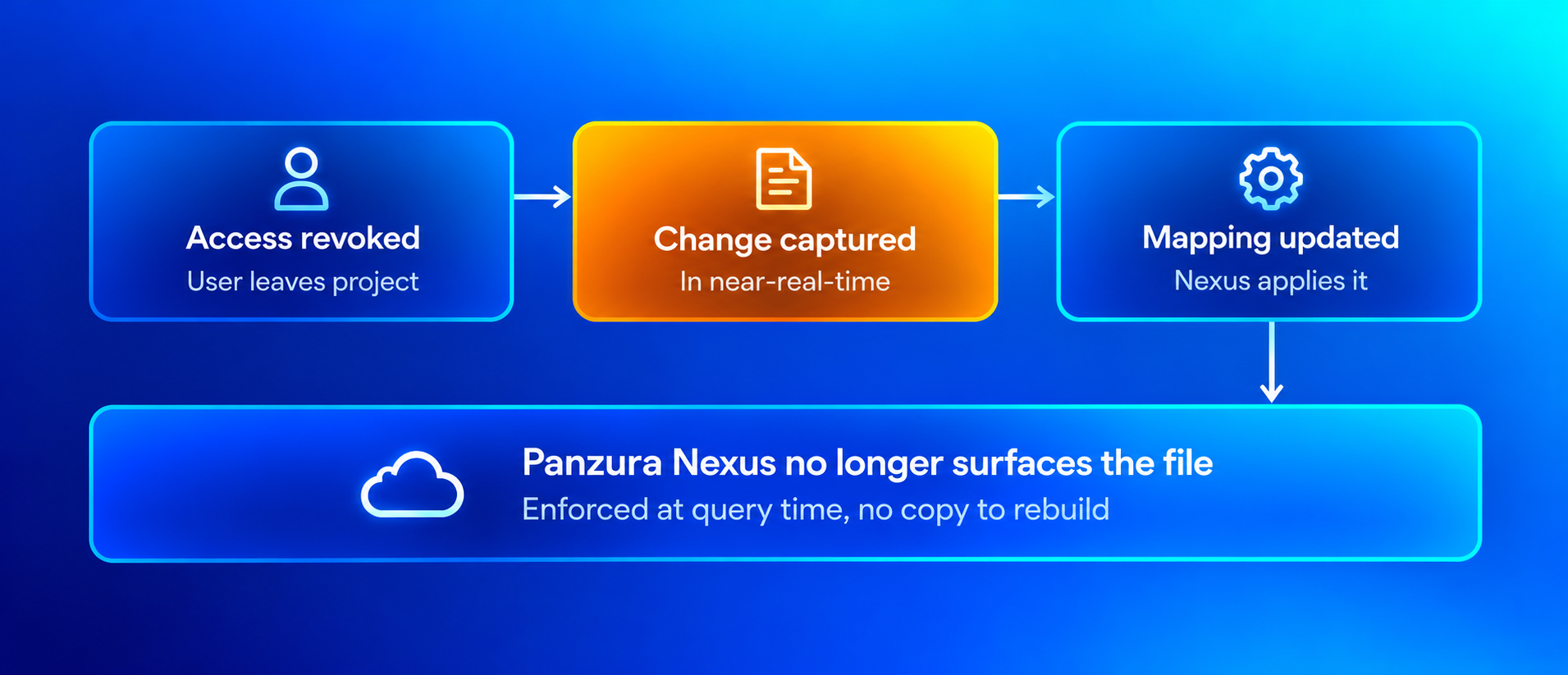
Panzura Nexus is built on that principle. As the governed bridge between CloudFS data and Microsoft 365 Copilot, Panzura Nexus preserves each file’s existing access controls. Copilot sees only what each user is already entitled to see; there is no separate data lake to secure, and there are no permissions to reconstruct by hand. Event-driven changes capture updates at the retrieval layer, and access is enforced on the Copilot side of the query against mapped permission.

In our view, preserving the initial permission model is only part of the requirement, however. A user may leave a project, a folder may become restricted, or group membership may change. AI access must reflect those changes as well. This is how AI initiatives stay aligned with an organization’s security posture as they scale.

Panzura Nexus delivers permission-change propagation in near-real-time. We recommend that buyers validate the elapsed time between revoking file access and preventing a new Copilot retrieval using their own identities, groups, and folders. Panzura believes that an observable update and revocation workflow is a more useful measure of governed AI than a connector demonstrates alone.

Image 2: Panzura Nexus keeps Copilot inside the permissions you set  

Real-Time Access Revocation Flow

Consolidation Is Where AI Readiness Starts

One of the Strategic Planning Assumptions in the report states, “By 2029, more than 60% of enterprises will replace separate storage products with a single storage platform serving both structured and unstructured data services, up from less than 25% in early 2026.”

In our view, this speaks to platform consolidation, with a forecast reinforces the importance of reducing operational fragmentation. Panzura sees consolidation as the practical first step toward AI readiness. An AI system can only produce a trustworthy answer from data that can be identified, located, and verified. File shares that nobody has opened in years, duplicate working sets left behind by past migrations, and branch servers that central systems cannot see can complicate decisions about which data should be made available.

Panzura Symphony delivers data mobility, orchestration, migration, and lifecycle management across storage environments, and CloudFS provides search and audit so teams can see what the estate holds before AI systems are pointed at it.

From our perspective, the business case should identify which redundant systems, migration steps, administrative tasks, and separately maintained data sets can be retired. Consolidation is valuable when it removes operating burden instead of introducing another management layer.

Recommendations for Infrastructure Leaders

In the report Gartner says, “Build a business case for hybrid cloud storage that extends beyond terabyte pricing and emphasizes workflow efficiency, streamlining operations and storage standardization.”

Gartner also states, “Choose a hybrid cloud storage provider based on additional services provided, such as metadata insights, cybersecurity, global access, life cycle management, multicloud support, performance enhancement, and data analytics.”

Panzura suggests turning these recommendations into operational tests. As we see it, the most useful comparisons measure the complete workflow, including the required licenses, infrastructure, configuration, and administrative effort. To meet these benchmark tests, Panzura provides a suite of connected platforms designed to streamline performance across the entire data lifecycle.

Panzura CloudFS provides search and audit visibility across a global namespace, builds behavioral fingerprints with automated responses and immutable snapshots, and maintains a single global namespace with real-time file locking against an authoritative dataset. CloudFS also exposes governed file data natively via S3 alongside SMB/NFS, while intelligent edge caching delivers LAN-speed access to data.

Additionally, Panzura Symphony enables comprehensive data mobility and lifecycle management across storage systems while running seamlessly across major cloud environments and S3-compatible object storage. Finally, Panzura Nexus connects CloudFS directly to Microsoft 365 Copilot with full permission fidelity, enabling users to query files and get meaningful answers.

What Panzura Takes from the Recognition

Panzura is pleased to be named as a Sample Vendor in the Gartner report, and we are grateful to the customers whose deployments continue to shape our understanding of the category. We are proud to build the solutions our customers need to drive their success forward.

From our view, the report confirms that storage and AI decisions have become one decision. The file platform an organization chooses now determines how much of its unstructured data AI can reach, how safely agents can write to it, and how dependably permissions follow the data wherever it goes.

Panzura’s case rests on how CloudFS and Panzura Nexus work. That includes coordinating distributed file access, providing multiple protocol paths to the file estate, applying geographic controls, and connecting content permissions to AI retrieval. We believe those mechanisms should be demonstrated against a buyer’s real-life workflows.

Talk to a Panzura expert and see CloudFS, Panzura Nexus, and Panzura Symphony at work against your file estate.

Hand off an active file between locations, change a user’s permissions, test a geographic restriction, and recover a selected set of changed files.

Explore More with the Following Resources

Panzura has been named as a Representative or Sample Vendor in three additional Gartner reports this year, spanning strategic cost management, hybrid cloud storage, and cyberstorage. For our view on what hybrid cloud storage means for technology cost, read our analysis of the Gartner Hype Cycle for Strategic Cost Management, 2026 here. For our perspective on the Gartner Market Guide for Hybrid Cloud Storage, 2026, read our analysis here. For our take on the Gartner Market Guide for Cyberstorage, 2026, read our analysis here.

____________

[1] Gartner®, Hype Cycle for Storage Technologies, 2026, Julia Palmer, 1 June 2026

Gartner and Hype Cycle are the trademark of Gartner, Inc. and/or its affiliates

Gartner does not endorse any vendor, product or service depicted in its research publications, and does not advise technology users to select only those vendors with the highest ratings or other designation. Gartner research publications consist of the opinions of the Gartner research organization and should not be construed as statements of fact. Gartner disclaims all warranties, expressed or implied, with respect to this research, including any warranties of merchantability or fitness for a particular purpose.


Frequently Asked Questions (FAQs)

  • Why does agentic AI change the requirements for enterprise file storage

    Autonomous AI agents actively read, write back to shared files, and inherit user permissions, moving far beyond traditional AI workloads that only read static data. This shift introduces diverse data flows and unstructured data lakes that demand a storage layer capable of multi-site data reach, strict concurrent consistency, and robust governance. According to Gartner research, hybrid cloud storage is essential for unifying on-premises, edge, and public cloud environments to support distributed AI pipelines and metadata management. A platform like Panzura CloudFS handles these overlapping operational demands by maintaining a single authoritative dataset without fracturing workflows.

  • How does Panzura CloudFS make file data available to AI pipelines?

    Panzura CloudFS maintains an authoritative dataset in object storage and serves it globally through a single namespace. By exposing governed data natively via S3 alongside traditional SMB and NFS protocols, RAG frameworks and AI pipelines can connect straight to production data. This eliminates complex ETL staging steps and source-data staging environments, allowing AI systems to analyze the exact live files employees use daily.

  • Why do AI agents writing to shared files need global file locking?

    Agentic workflows mean agents create, edit, and save files alongside human workers. When multiple agents or users modify the same file concurrently across offices, uncoordinated edits cause version divergence and collisions. Panzura CloudFS enforces real-time global file locking and distributed ownership management against a single authoritative dataset. When control moves between nodes, CloudFS coordinates handoffs and transfers outstanding changes before the new owner begins local I/O, ensuring work continues smoothly without revision collisions. This is reinforced by immutable snapshots created every 60 seconds by default and user behavioral fingerprinting to detect and mitigate anomalous or malicious changes.

  • How does Panzura Nexus keep Microsoft 365 Copilot within existing permissions?

    Panzura Nexus acts as a governed bridge between CloudFS data and Microsoft 365 Copilot by preserving native access controls. Copilot only surfaces content authorized for the specific user executing the query, meaning there is no separate data lake to secure or hand-reconstruct. Furthermore, because permission changes (such as a user leaving a project or group membership shifting) propagate in near-real-time, security teams maintain complete, dynamic governance as AI adoption scales.

  • Should organizations build a separate data lake for retrieval-augmented generation

    Organizations should follow Gartner’s recommendation to avoid creating separate data lakes for RAG use cases if existing enterprise storage can deliver the required performance and data management capabilities. Every copied dataset introduces security overhead, maintenance friction, and version drift away from production truths. Panzura allows AI tools to securely index and query live, production-grade file data directly in place while maintaining full permission fidelity.

  • How does hybrid cloud storage support data sovereignty and compliance for AI initiatives?

    High-value AI data is frequently restricted by strict regulatory, geopolitical, and data sovereignty mandates requiring sensitive data to remain in-country or on-premises. Panzura CloudFS supports these sovereign cloud models by allowing administrators to dictate exact storage placement—such as regional public clouds or local S3-compatible object storage—while enforcing precise file- and folder-level geofencing across SMB, NFS, and S3. This separates storage placement from geographic access decisions, ensuring restricted files remain compliant while accessible to authorized workloads.

  • What should infrastructure leaders evaluate in a hybrid cloud storage platform for AI?

    Infrastructure leaders should build business cases that extend beyond raw terabyte pricing to emphasize workflow efficiency, streamlining operations, and storage standardization. Evaluation criteria should test global access and consistency; protocol parity, governance, and copilot integration; and active cyberstorage defenses.


About the author
Mike Harvey
Mike Harvey

Mike Harvey is Senior Vice President of Product at Panzura. As a data management expert, he helps customers unlock the full potential of their data. As the former co-founder of Moonwalk Universal, he is passionate about building next-generation insight, compliance, and governance solutions that enable organizations to effectively manage and leverage their ...

Panzura Named as a Sample Vendor in the Gartner® Hype Cycle™ for Storage Technologies, 2026

Panzura Named as a Sample Vendor in the Gartner® Hype Cycle™ for Storage Technologies, 2026

Why Agentic AI Puts Unstructured File Data at the Center of Storage Strategy, and What to Ask of a File Platform

Procore and Panzura CloudFS: How the Project Platform and the File Layer Work Together

Procore and Panzura CloudFS: How the Project Platform and the File Layer Work Together

Procore Runs the Project. CloudFS Keeps Every File Behind It Current, Locked Across Offices, and Recoverable in Minutes, With No Connector and No...

A Valid Login Can Still Be an Attack. What Happens Next?

A Valid Login Can Still Be an Attack. What Happens Next?

Detect Suspicious Activity. Contain the Threat Precisely. Establish What Was Affected and How Quickly Access Changes Reach AI.