AI and Agentic Workloads
AI can read your files. Agentic will write to them.
Every platform in this market can hand AI a document. Whether you can actually deploy agentic workflows comes down to what happens when they write back — into an estate where dozens of people in a dozen offices are working the same project, and nobody is checking the machine's work.
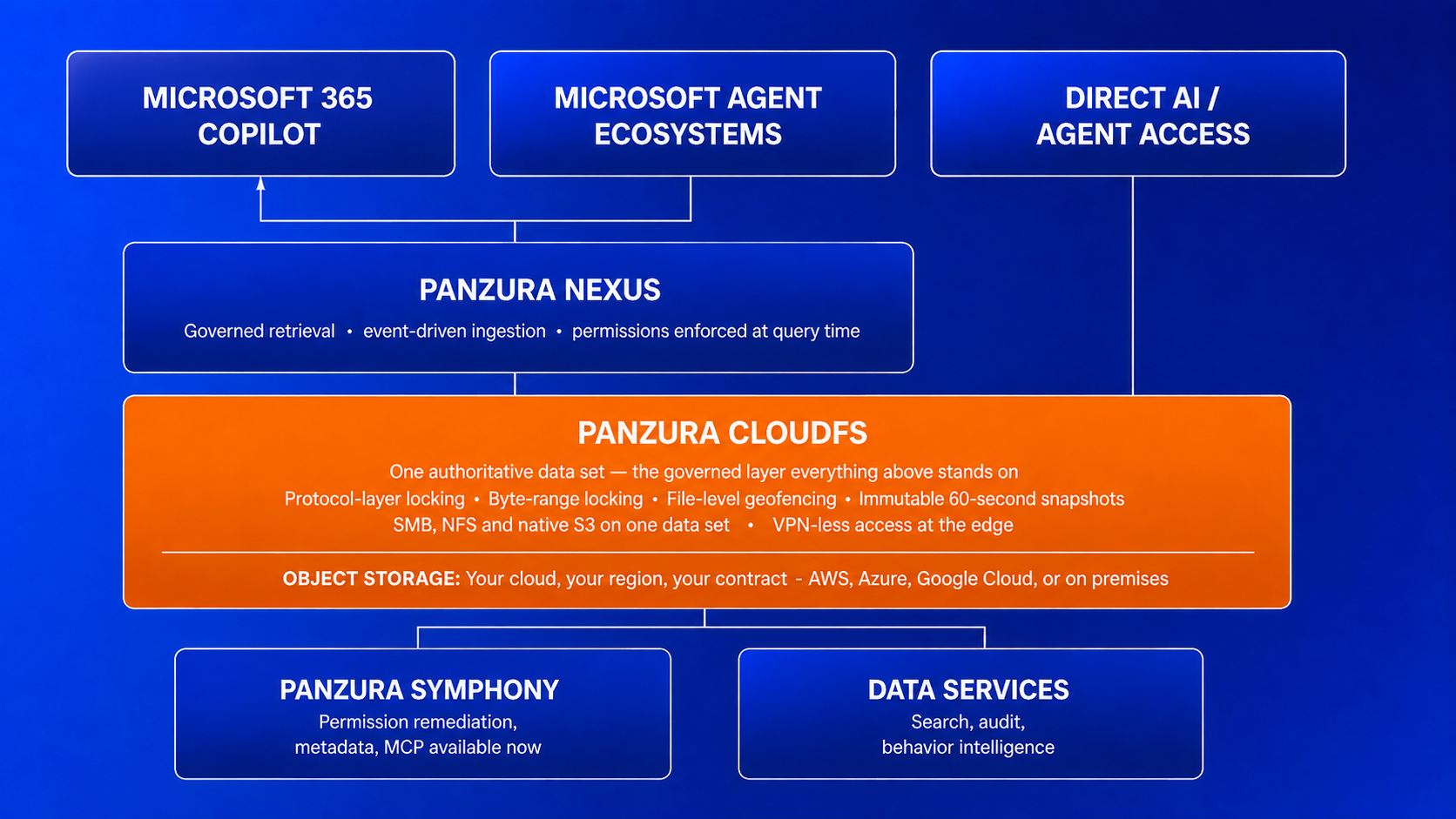
Panzura CloudFS enforces locking, geofencing, and immutability at the protocol layer, below whatever is reading or writing. A person over SMB, a pipeline over read-write S3, an agent acting through either — same rules, same data set, no exceptions. Panzura Symphony makes it possible to get file system permissions right before the AI journey starts. Panzura Nexus lets your team have conversational interactions with your files inside Microsoft 365 Copilot with permissions intact.
📄 Article | 8 min read | The Four Generations of RAG (And Why Panzura Nexus Lives in the Fourth)
Three questions to ask and why Panzura has the answers.
A demo always shows the same thing. A clean question, a curated folder, one user, an impressive answer. That is retrieval, and retrieval is the part the market has solved. What stalls AI deployments happens after that, in a live estate, with a hundred people and a handful of automated processes reaching the same files. An agent acts on what it retrieves and hands the result to the next step in a chain that also acts, so there is no judgment left in the loop to catch what the data layer got wrong. These three questions surface that before you commit. Start here.

Ask about when it writes. Retrieval is where every vendor competes. Writing is where the risk lives. If locking is held by a desktop client, brokered through a portal, or absent from the programmatic path entirely, an automated write and a human edit can collide with nothing underneath to stop them.
- Panzura CloudFS
- Locking at the protocol layer, so it governs a process exactly as it governs an engineer connecting from another site
- Byte-range locking, so people and automation can work the same file at once
- Every write is an immutable version — anything automation does can be rolled back to the desired snapshot

Ask about when it reads. Freshness on the read side is the easy half. The harder one runs backwards: when user access permissions have been revoked, how long until AI stops answering? An agent covers more ground in that gap than a person covers in a week.
- Panzura CloudFS with Panzura Nexus
- Ingestion follows file events so changes propagate in seconds
- Permissions evaluated at query time, so a revocation is applied to the next request
- Windows Explorer is the test: if a person cannot open it, their prompt cannot reach it

Ask about how it connects. Agents arrive over MCP, over a vendor connector, over S3, over whatever technology replaces those next year. If governance lives in the connector, you re-implement it for every tool you adopt and hope the implementations agree. If it lives in the data layer, you implement it once and it holds for the tools you have now as well as those that don't yet exist.
- Panzura CloudFS
- Geofencing enforced at the protocol, consistently over SMB, NFS, and S3
- GDPR, ITAR, and CMMC 2.0 boundaries met without separate storage per jurisdiction
- Read-write S3 on the same data set, not a read-only copy
- One audit stream covering every session, human or machine

Moor Insights & Strategy: Panzura Nexus Puts Teams in Front of Copilot Deployments
Mike Leone of Moor Insights & Strategy says cloud partnerships keep showing up as the dividing line in storage, and Panzura Nexus is among the cleanest examples.
📄 Expert Perspective | 2 min read
Why Experts Like 451 Research by S&P Global Are Paying Attention to Panzura
The file data Microsoft 365 Copilot can’t see is the data you most need it to know. Panzura Nexus fixes that and the experts are taking note.
📄 Article | 7 min read
To make file data answerable, you don't need a data transformation project.
The problem is not that AI cannot read a project-based file like a drawing, specification, or proposal. It is that most of what an organization knows lives in a file system that was never built to be queried. The common fixes copy the data somewhere, and now there are two estates to secure, fund, and keep in agreement. The alternative is to leverage the estate you have.
|
Approach
|
Migrate to a data lake
|
Point a connector at the share
|
CloudFS with Panzura Nexus
|
|---|---|---|---|
|
What you build
|
A parallel copy of the estate, plus the pipelines feeding it
|
An index maintained on a crawl schedule
|
The files stay where they are; knowledge is synchronized
|
|
Permissions
|
Rebuilt from scratch in the new system, and drifting from day one
|
Mapped approximately, enforced at index time
|
Enforced in real time, and mapped to Entra ID claims for Copilot
|
|
Freshness
|
As current as the last pipeline run
|
As current as the last crawl
|
Event-driven — updates happen in near real-time
|
|
Revoking access
|
Manual, in two systems
|
Takes effect at the next crawl
|
Takes effect on the next prompt
|
|
Time to value
|
Typically, 6 months or more
|
Weeks to months, then ongoing reconciliation
|
A dry run on one project tree, then days to weeks depending on scale
|
|
What you own
|
Two estates, two security reviews, two bills
|
An index that is a second access surface with permission drift
|
A connected knowledge surface, governed automatically, used by people and machines alike
|
← Swipe to see more →
How the estate behaves
One estate, one set of rules, four things that keep it that way.
An estate that AI can safely read and write has to do four things: enforce permissions before anything is exposed, hold the line when something writes to it, know what was reached afterwards, and answer where people actually work. Those are one continuous job, and Panzura builds them as one platform. Every additional line item in this market is another license, another security review, and another thing that can quietly fall out of step with the others.
📄 Article | 9 min read | One Platform, Three Operational Modes: Why Stitched Together File Infrastructure Can’t Survive the AI Era
Panzura Symphony. No security expert approves pointing AI at an estate nobody can vouch for — and in most organizations, hundreds of thousands of files are overshared. Symphony analyses permissions, reports on anomalies, and enforces inheritance, on CloudFS and on other enterprise file systems.
- ACL analysis and automated enforcement of inherited permissions before ingestion
- Custom metadata (EA) applied to files, so AI can discriminate between datasets
- MCP available — file metadata is queryable: what exists, who can reach it, where it is

Panzura CloudFS. A single authoritative global file platform backed by object storage, with file locking, geofencing, and immutability enforced on every client — human or machine. Same rules, same file, no exceptions.
- A locked or open file cannot be overwritten. Not by a person, an agent, or by a machine account
- Write access runs through ownership. An agent's node path has to become the data owner before it can change anything, and that takes a deliberate permissions change
- File owner and data owner stay two different things. Automation doesn't collapse them
- Native S3 lets pipelines read the same files your teams have open

Panzura Data Services. Opening an estate to automation widens the surface being traversed, quickly and without anyone watching in real time. PDS is the record of what was reached and Threat Control spots behavioral anomalies, human or machine, when the pattern changes.
- File activity audit showing who — or what — reached which file, when
- User Behavior Intelligence baselines activity and flags anomalies as access patterns change
- Audit events persist in PDS; anomaly alerts sent to SIEM

Panzura Nexus. Retrieval into the Microsoft 365 Copilot your teams already use, with file system permission mapped to Entra ID and enforced on each query. Ingestion follows file events rather than just a schedule, so a content change and an access revocation both propagate in seconds.
- No migration, no re-permissioning, no parallel data lake
- Content is available to the Copilot ecosystem with full permission fidelity for agentic prompts
- Priced on source capacity
- Available now with a roadmap to additional file platforms and AI experiences

Panzura Nexus
A seamless end user experience with Copilot.
Someone asks Microsoft 365 Copilot a question about a project from the past. The answer is returned with all source files cited. Panzura Nexus ingests file events and enforces permissions on every query. There's no need to move a file or learn a new tool and end users cannot find or retrieve a file, or know its contents, if their permissions did not already allow it in the file system.
📄 Article | 7 min read | Introducing Panzura Nexus: Copilot, Meet Your Files
MCP and what comes after it
On protocols and what is on the other end.
The Model Context Protocol standardizes how an agent reaches data. Every platform in this market will support it, and support is not a differentiator. The question worth asking is what the protocol connects to.
Point MCP at a file system and an agent gets a file system — paths, names, and blobs. It still has to work out what relates to what by walking the tree, which is slow at project scale and expensive every time it repeats. The Panzura Nexus MCP operates over a semantic layer and a knowledge graph rather than a directory structure, so all relationships are resolved ahead of time. The agent spends its tokens on the question instead of the structure.
-
Panzura MCP servers — MCP interfaces under development across the Panzura portfolio with early release options available now.
- Available today without MCP — Secure agent access and conversational interaction through Microsoft 365 Copilot, and read-write S3 to any framework your teams build on
And to answer the obvious question: if the Panzura AI stack is vendor-agnostic, why is so much of this about Microsoft? Because Copilot is where most enterprise teams already interact, the depth of the Panzura Nexus integration is a choice about today's customers. The foundation underneath — a different retrieval layer, a new framework, the same protocol — requires no retooling.
GEO-FENCED AND SELF-HOSTED
AI on infrastructure you control.
Defense contractors, government agencies, and organizations under ITAR or CMMC 2.0 hear the same thing repeatedly: AI on your file data means moving that data to a hyperscaler's service. For a lot of organizations, that ends the conversation. But that is not the only option. In support of data sovereignty and governance initiatives, CloudFS exposes tightly controled file data over read-write S3 to both end users and agents. Geofencing is enforced at the protocol layer regardless of what the pipeline was told to do.
📄 Press release | 5 min read | Panzura CloudFS Tackles $3.1 Trillion Data Silo Problem with Geofencing and Native S3 Interface
- Self-hosted models read the same governed data set your teams work in
- Air-gapped and regional deployments supported without a separate product
- FIPS 140-3 certified encryption, at rest and in transit
Start where you are in your AI journey.

CloudFS 8.7 provides a foundation for agentic and AI workflows by making project metadata and version history accessible without requiring separate data lakes or costly rip-and-replace migrations. The latest capabilities in 8.7.1 add ring-wide health visibility and audit streaming to several platforms at once. Previous versions provide geofencing and data residency capabilities.
- Check your release — earlier versions predate the metadata and audit work agents depend on
- Prewarm one project tree so retrieval starts with context rather than a cold cache
- Scope the upgrade with your Panzura customer success team before ingestion planning begins

Panzura Nexus ingests the project trees you choose and makes them retrievable inside M365 Copilot, governed by existing permissions. Nobody learns a new interface and nobody buys a new seat. Start with the files you choose, confirm what comes back and what correctly does not, then widen.
- Start with as little or as much data as you like
- Dry run against a single closed project
- Observe that file permissions are enforced in every Copilot conversation, giving your security team the confidence they need

An organization in one location does not need a multi-site deployment to get AI-ready file data. Panzura Express is CloudFS licensed for a single site with a local high-availability node pair, Panzura Data Services, and Panzura Nexus included, delivered by a Panzura partner. Same code, same governance, same retrieval path — and growing to a second site is a license change rather than a migration.
- Talk to a Panzura partner about a single-site deployment
- Panzura Nexus is in the bundle, so Copilot retrieval is available from day one
- Add sites later without re-platforming

Panzura Express and Panzura Nexus Give Small and Mid-Sized Firms Something Copilot Can’t See: AI File Intelligence
Mid-market firms are paying for Microsoft 365 Copilot and getting thin answers, because their competitive knowledge sits in files Copilot can’t see. Panzura Express bundles CloudFS and Nexus into one license that gives a lean team enterprise-class AI file intelligence.
Evolving Historical Metadata Distribution in Panzura CloudFS with New Snapshot Retention Capabilities at the Edge
CloudFS introduces site-scoped snapshot retention, allowing each edge node to carry only a defined window of historical version metadata rather than the full global version history, while the complete record remains preserved in backend object storage.
On-Demand Webinar: Microsoft 365 Copilot, Meet Your Files. Panzura Nexus is Here.
Join Mike Harvey, SVP of Products, and Darrin Chapman, Senior Director of Product Marketing, and see Panzura Nexus in action — including a walkthrough of how the platform connects CloudFS to Microsoft 365 Copilot and prepares your environment for the next wave of agentic AI workflows.