Cyber Resilience
AI-powered threat detection and mitigation inside the file platform. Recovery nothing can delete.
Panzura CloudFS uses AI to build a behavioral fingerprint for every user, flags anomalous behavior and exfiltration in real time, then allows compromised accounts to be disabled. Detection runs inside the file platform itself — no cloud round trip to analyze activity, and no agent on the endpoint consuming resources.
Behind it, the platform has written every file as an immutable object, so the way back exists whether or not a breach or data loss event was caught in time. Immutability means it cannot be altered or deleted by anyone, including an attacker holding valid credentials.
Threat Control detection, no agent, no cloud round trip · Immutable from the first write · Panzura Symphony remediates permissions before an attack · Data Services keeps the audit record · Panzura Nexus makes file data askable in Copilot
Are you a single-site organization? Panzura Express is all the platform, including AI-powered cyber resilience and an HA node pair, no hardware required.
What cyber resilience for file data really means.
Every file platform in this category now claims ransomware protection. The differences show up in three places, and two of them are what buyers have started measuring: how quickly something is detected, and how much confidence there is that recovery will hold. It comes down to whether there is one truth to go back to, whether protection is always live, and whether it reaches everywhere — every protocol, every permission, and every file data consumer, including AI. Ask us. Ask everyone.

Industry research consistently finds that the overwhelming majority of ransomware attacks target backups, because destroying the way back is what converts an incident into a payment. Ask where the recovery copies live, what can delete them, and whether an administrator credential is enough to do it. If the answer involves a retention setting somebody configured, it is a policy rather than a property. CloudFS offers:
- Every file version is written as an encrypted WORM object — immutable from the first write, with no configuration necessary
- Recovery points cannot be modified or deleted, including by a credentialed attacker
- Changed data is written as new immutable blocks every 60 seconds, so a clean version exists within a minute of any write; snapshots are named recovery points on top of that, retained by policy for as long needed

Signature-based tools catch what has been seen before and flood the console with the rest. What matters is how quickly unusual behavior is recognized as unusual, and whether recognizing it costs you performance — some approaches route analysis to the cloud, others put agents on endpoints. CloudFS with Threat Control delivers:
- AI builds a behavioral fingerprint for every user, so deviation is measured against that person rather than a signature list
- Encryption, mass deletion, bulk creation, erratic access and exfiltration flagged in real time
- Patent-pending distributed detection — no cloud round trip, no endpoint agent, no measurable impact on user workloads
- Compromised accounts disabled and affected areas quarantined automatically

This is the question that separates the competition, and it is rarely on a datasheet. Some detection is scoped to Windows file sharing and does not watch what arrives over other protocols. Some runs only where an endpoint agent is installed. And almost none of it accounts for the permissions that decide what a compromised account can reach in the first place, or for the AI tools now reading the same estate.
- CloudFS — detection built into the file system rather than bolted alongside it, with geofencing and access rules enforced at the protocol layer across SMB, NFS, and S3
- Panzura Symphony — the permissions that define reach, analyzed and remediated across CloudFS and third-party estates alike
- Panzura Data Services — one audit feed covering every path, streamed to your SIEM and compliance platform together
- Panzura Nexus — AI retrieval governed by file permissions themselves
Five Mechanisms
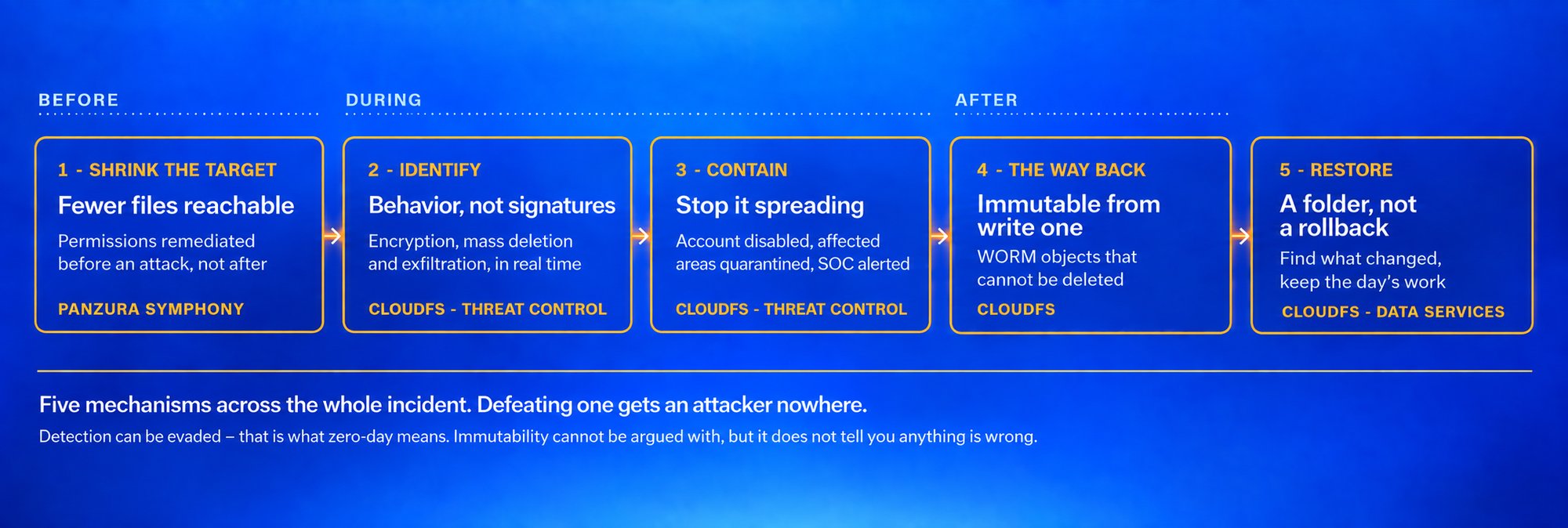
Defense in depth across an entire incident.
File data resilience is three jobs, not one. Identify what is happening, contain it before it spreads, and recover without losing the work. Detection can be evaded — that is what zero-day means. Immutability cannot be argued with, but it does not tell you anything is wrong. Panzura puts all three in the data layer rather than beside it, with the attack surface reduced before an incident begins.
📄 Article | 5 min read | CloudFS Just Got Smarter with AI-Powered Threat Control
📄 Press release | 5 min read | Panzura CloudFS Reimagines File Data Defense with New AI-Powered Threat Control
How recovery points work
Two critical clocks and a snapshot that cannot be defeated.
Recovery point objective is usually quoted as a single number. In CloudFS it is two mechanisms doing two jobs — one that decides whether a clean version exists at all, and one that decides the precision of the moment you can return to. Thirdly, it matters what it costs to keep recovery points, and what it takes to destroy one.
📄 Article | 15 min read | The Latest Features in CloudFS and the Work You No Longer Have to Do by Hand
📄 Article | 5 min read | CloudFS Just Got Smarter with AI-Powered Threat Control
📄 Press release | 5 min read | Panzura CloudFS Reimagines File Data Defense with New AI-Powered Threat Control
The write interval
Does a clean version of the file exist at all?
Every 60 seconds, file changes are written to object storage as new immutable blocks that have no effect on the blocks already there. Continuous, automatic, nothing waiting on a nightly job. This is the clock that decides whether ransomware can destroy your work, because within a minute of any write there is an unaltered version in the object store.
The Snapshot Schedule
How precisely can you choose a moment?
A snapshot is a read-only, point-in-time reference to blocks that already exist and cannot change — a named recovery point. It runs on a schedule you set with a minimum interval is 15 minutes. Administrators tune it against their own activity: hourly through quiet periods, tightened to 15 minutes when people are creating and changing the most.
What it Costs
How does it work and is it alterable?
Snapshots cost practically nothing. They use redirect-on-write, so no data block is ever overwritten to create one. No data moves, no window is consumed, there is no practical limit on how many you keep, and retention is set by policy. A snapshot cannot be deleted through the file protocol. It cannot be removed or altered by someone with sufficient privileges.
Before the attack
The blast radius you control.
After a decade of projects and staff departures, the attack surface could be hundreds of thousands of files. Most breaches abuse legitimate credentials. Panzura Symphony analyzes file permissions, surfaces anomalies, and corrects broken inheritance automatically across file platforms like CloudFS as well as third-party estates like Windows, NetApp and Isilon. It is a separate platform by design, which means the clean-up can start now on the storage you have today.
-
Automated ACL scanning, anomalous findings highlighted
-
Runs against existing file storage, not gated on a platform decision
-
Broken inheritance corrected automatically during policy execution
Contain it, then recover with true business continuity.
Identifying an attack is the first job and the least useful on its own. What decides the cost of the incident is how quickly it stops spreading, how precisely you can see what it touched, and whether restoring means recovering a folder or rolling an estate back to yesterday — which protects the data and destroys the work. Consider that RPO is an abstraction until it is said in plain terms: if this happens, how much work does the company redo? In most environments the honest answer is a day or more, and it has been true for long enough that people stopped hearing it as a problem. What firms increasingly want is recovery confidence — identifying the last known clean copy and knowing the restore will behave under active attack conditions rather than in a test.

Threat Control. When behavior crosses the line, the compromised account is disabled and the affected areas are quarantined automatically — no waiting for someone to read an alert. Because detection is per-user and behavioral, containment is scoped to the account and the files it touched rather than taking a share offline. Incident evidence is logged as it happens, and audit events stream to your SIEM from the same feed everything else uses.

Panzura Data Services. Global search finds files that were deleted, moved or renamed across the whole estate, and file activity audit shows who — or what — touched them. The incident record narrows the window before anyone starts restoring, so the question stops being "when were we last clean" and becomes "which folder, and from when."

Panzura CloudFS. Point-in-time recovery to any file or folder, restored in place from a named snapshot. Unaffected work stays where it is. Any site can serve any data, so a location taken offline during the incident is not a separate recovery project afterward.

The Vulnerability You're About to Add
Every AI you deploy is another attack surface.
An agent inherits whatever permissions it was given and covers more ground in a minute than a person does in a week. A revocation that does not take effect for a day is a day of exposure.
The common answer is a policy layer governing which files AI may reach — a second set of rules about the same data, which eventually disagrees with the first. Panzura Nexus enforces access at query time from the file system permissions themselves. There is no second policy to maintain, and a revocation takes effect in near real-time.
-
No data lake or migration project required
-
If a user cannot open the original file, they cannot reach it through AI either
- Metadata, content and permission changes to the file system are propagated in near file-time
Independent Validation
Where the experts place Panzura when it comes to cyber resiliency.
The 2026 Gartner® Market Guide for Hybrid Cloud Storage Recognizes Panzura
From our perspective, Panzura's recognition reflects the maturity of the CloudFS platform, delivering a global namespace, intelligent edge caching, integrated threat detection, and governed AI data access across on-premises, edge, and cloud environments.
📄 Article | 9 min read
Panzura Named a Representative Vendor in the Gartner® Market Guide for Cyberstorage
We believe this shift from reactive recovery to recovery confidence reflects a broader market transition, validating the integration of active defense and AI-powered threat detection directly within Panzura’s CloudFS hybrid cloud file platform.
📄 Article | 7 min read
Panzura is Definitive Innovator in $100B Hybrid Cloud Storage Market in Frost Radar™
Frost & Sullivan says Panzura CloudFS offers technical advantages and key innovations including 60-second RPO, the best in the industry, security features like real-time threat detection, support for cloud providers, and cruicial AI-readiness.
📄 Article | 6 min read
CloudFS Wins Gold Globee® Award for Disruptors for Business Continuity
Panzura CloudFS has been awarded a Gold Globee® Award for Disruptors in the business continuity category, selected for the top honor by more than 1,680 experts amid the $110.53 billion enterprise data management market.
📄 Press release | 5 min read
CloudFS Wins Gold and Best of Ransomware Category in Globee® Awards
The 20th Annual Globee Awards for Technology have awarded Panzura CloudFS with Threat Control with a Gold Globee® and named the solution the Best of Category for ransomware protection.
📄 Press release | 5 min read
Panzura Wins Coveted SaaS Award for Best Use of SaaS in a Cloud Ecosystem
Panzura CloudFS has won the 2025 SaaS Award for Best Use of SaaS in a Cloud Ecosystem, recognizing the use of cloud services to provide resilient, globally accessible file data with enhanced visibility and control.
📄 Awards | 4 min read
Take steps to better cyber storage resilience now.
For Panzura customers, this begins as a version check rather than a purchase. Where it does not, the next move is to scan your file estate with Panzura Symphony and bring the results to your security team. If you're a single-site firm, you can begin with Panzura Express which is all the CloudFS platform including cyber resilience and an HA nodes pair.

Threat Control arrived with recent releases, and multi-consumer audit streaming means your SIEM and your compliance platform can take the same feed. If you are on an older version, the AI-powered detection layer may simply be a upgrade.
- Check your release and confirm Threat Control is active
- Point the audit stream at your SIEM
- Scope the upgrade with your CSM

Run Symphony against one file server and count what a single compromised account could reach. It works on third-party storage, so this costs nothing in platform commitment and usually produces a figure that changes the conversation internally.
- Pick one server with a long history
- Analyze file permissions
- Take the number to your security review with Panzura

One location does not mean lower exposure, and smaller IT teams have less capacity to absorb an incident. Panzura Express is CloudFS for a single site with a local high-availability node pair, Panzura Data Services and Panzura Nexus included, delivered by a Panzura partner.
- Talk to a Panzura partner
- Skip the hardware queue because Panzura Express doesn't require any
- When you grow, add sites without re-platforming