INTRODUCING PANZURA CLOUDFS 8.7
Cut Costs. Simplify Management. Prepare for Agentic and AI Workflows.
The latest version of the Panzura CloudFS hybrid cloud file platform, CloudFS 8.7 provides measurable reductions in infrastructure cost and operational overhead for architecture, engineering, and construction (AEC) firms and other project-based organizations scaling across global offices. New capabilities optimize snapshot placement, give IT teams direct self-service control, and strengthen data governance—while laying the architectural groundwork for AI and agentic workflows.
Click below to experience the on-demand webinar “Introducing Panzura CloudFS 8.7" and learn more about it. The platform that manages your data is the platform that drives intelligence.
Four Keys to Smarter File Infrastructure
What's New in CloudFS 8.7
CloudFS 8.7 delivers new capabilities that lower infrastructure and management costs as organizations grow and expand —while providing a pathway to the agentic future. It addresses the structural barrier between your file data and the AI workloads that can operationalize it.
Adaptive Snapshot Retention
CloudFS 8.7 optimizes snapshot placement by aligning retention with each node's role: full version history where files originate, just the working set everywhere else. Infrastructure costs decrease as deployments scale — and data is organized the way AI indexing demands.
Business Impact:
- Storage costs decrease or stay the same as you add offices and nodes, not increase
- Full version history preserved at file-owner (core) nodes for compliance and recovery
- Reduced global metadata burden accelerates AI indexing and storage tiering
- Aligns data gravity with operational responsibility across the mesh
Self-Service Administration
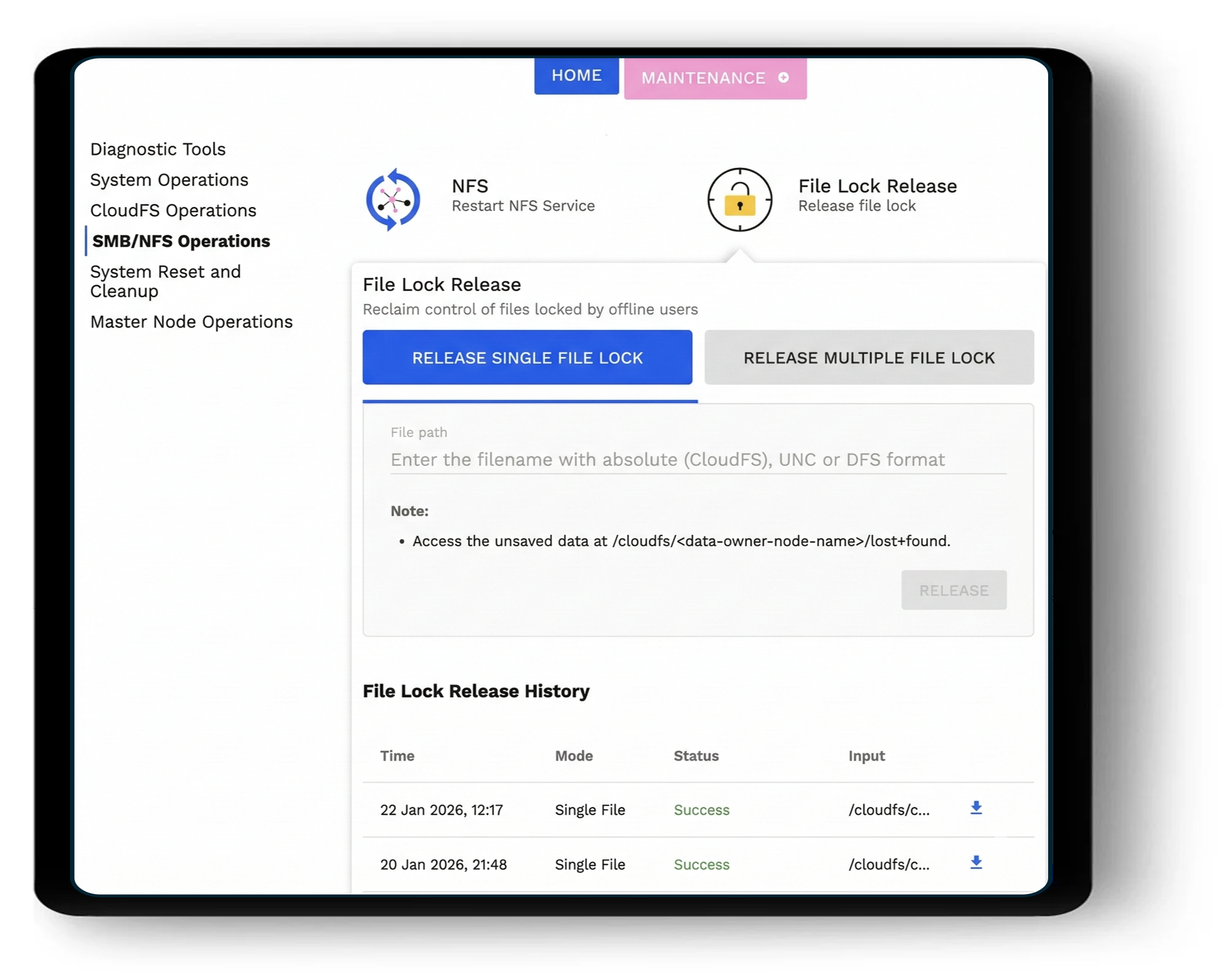
File Lock Release, Prewarm Provisioning, and Health Check Diagnostics put operational control directly in IT's hands. Win a project in a new market? Prewarm Provisioning delivers the full dataset to your local node on day one. Revit model locked by an offline user? File Lock Release resolves it in minutes, not hours. No escalation, no waiting — all driven by the customer's IT staff.
Business Impact:
- New offices are productive on day one with full project data prewarmed locally
- Locked file resolution drops from hours to minutes with no vendor escalation
- IT teams proactively diagnose and resolve issues directly via built-in health checks
- Autonomous operations support AI-driven workflows without manual intervention
User Behavior Intelligence
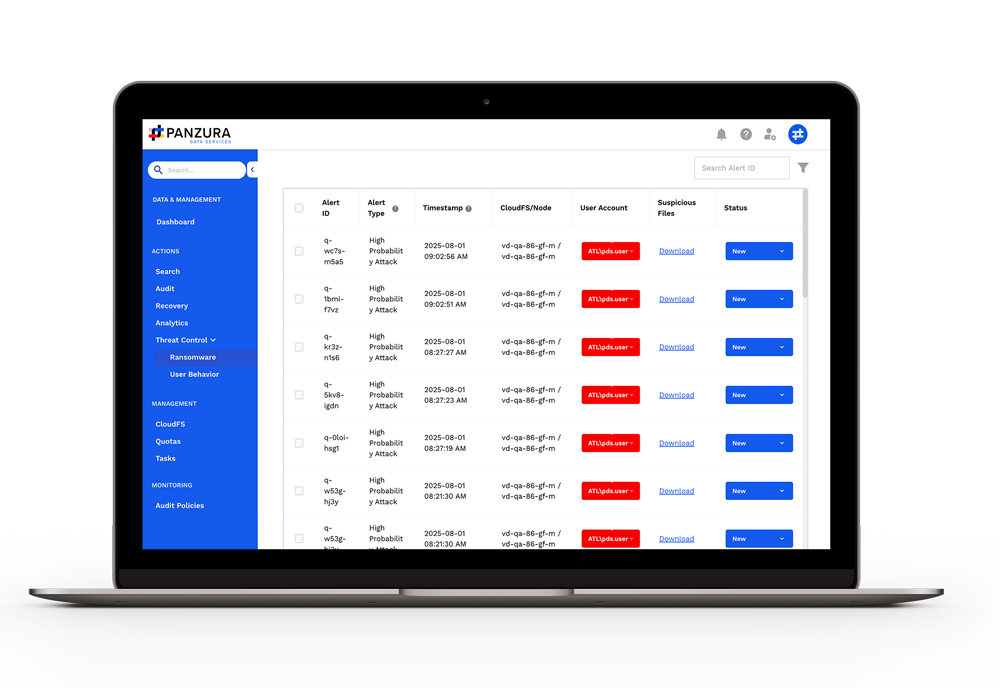
AI-powered threat control now profiles user activity and visualizes anomalies before they become incidents — critical as organizations expose more project data to AI workloads. Security teams can filter investigations by data owner and sync logs directly with SIEMs including Splunk Cloud.
Business Impact:
- Anomalous user behavior detected before it becomes a data loss event
- Sensitive client data stays protected as AI access to project files expands
- Investigations accelerated with data-owner filtering and SIEM integration
- Helps meet strict legal and contractual security obligations for regulated projects
Where File Infrastructure Meets AI
CloudFS Capabilities Mapped to AI and Agentic Workloads
The capabilities in CloudFS 8.7 aren't just operational improvements—they're architectural prerequisites for AI and agentic workflows. Here's how each maps directly to the demands of autonomous, data-driven operations.
|
CloudFS Capability
|
What It Does
|
Why It Matters
|
|---|---|---|
|
Native S3 Access
|
Exposes governed file data via S3 alongside SMB/NFS
|
RAG frameworks and embedding pipelines connect directly without ETL or staging
|
|
Byte-Range Locking
|
Real-time file locking at the byte level across all locations
|
AI operates on current data; eliminates stale-copy risk in multi-office workflows
|
|
File-Level Geofencing
|
Enforces geographic access policies per file across all protocols
|
Autonomous agents respect GDPR/ITAR boundaries without separate policy engines
|
|
AI/Agentic Data Access
|
Enforces geographic access policies per file across all protocols
|
Autonomous agents respect GDPR/ITAR boundaries without separate policy engines
|
|
Adaptive Snapshot Retention
|
Reduces global metadata overhead while preserving version history
|
Accelerates indexing and query performance for low-latency agentic operations
|
|
Prewarm Provisioning
|
Makes complete datasets instantly available on new nodes
|
Eliminates cold start; agents gain full project context from day one
|
|
User Behavior Intelligence (UBI)
|
Behavior analytics, anomaly detection, and ownership-filtered search
|
Maintains security posture as autonomous agents traverse expanded data surfaces
|
|
Immutable Snapshots (60s RPO)
|
Continuous snapshots with industry-leading recovery point objective
|
Opens data aperture for AI without compromising recoverability or compliance
|
← Swipe to see more →

“CloudFS 8.7 gives us a true single source of truth for our unstructured project data on the same platform we already trust for collaboration and security. It eliminates the costly, fragmented integrations that have long prevented us from fully leveraging our institutional knowledge for advanced analysis.”
— Andy Knauf, Chief Information Officer, Mead & Hunt
Bridging the AI Divide
From Project Files to Project Intelligence
The AI conversation has been almost entirely about models and algorithms. But for project-driven organizations, the real barrier is accessing the data that matters. According to research from Omdia, data management and data quality issues are a top-two challenge for organizations implementing AI, second only to cost. Data privacy, IP, and security concerns rank third.
CloudFS 8.7 addresses all three. By consolidating project files, metadata, and version history into a single governed namespace, it makes decades of institutional knowledge accessible to AI pipelines — without a separate data lake, a migration project, or integration middleware standing between your expertise and the AI workloads that can unlock it.
- Project files, metadata, and version history consolidated into a single governed namespace — accessible to AI pipelines without a separate data lake or migration project
- No integration middleware standing between institutional knowledge and the AI workloads that can operationalize it
- Decades of project data queryable for new proposals — specifications, cost benchmarks, and lessons learned available to AI-driven business development
- Architectural prerequisites for agentic AI built into the file platform: consistent permissions, metadata enrichment, and controlled ingestion
- More than half of AEC firms already use AI in business development and proposal writing, with AI-integrated firms reporting a 50% median proposal win rate (According to OpenAsset's 2025 AEC Trends)

“Extracting value from institutional knowledge through AI requires file platforms where governance, protection, and intelligent access operate as core architectural principles, not bolted-on integrations. Platforms like Panzura CloudFS that unify these capabilities within a single authoritative namespace demonstrate the infrastructure evolution necessary for AI-driven competitive advantage.”
— Simon Robinson, Principal Analyst, Omdia
NO SEPARATE INFRASTRUCTURE STACK
CloudFS: The File Platform is the Data Layer
Every AI initiative starts with the same question: can you get to your data? CloudFS answers it by making the file platform itself the authoritative data layer — governed, protected, and accessible to AI workloads without requiring a separate infrastructure stack.
|
Requirement
|
Header
|
Panzura CloudFS Advantage
|
|---|---|---|
|
Data Currency
|
Eventually consistent; copies lag by hours or days
|
Real-time; global byte-range locking ensures single authoritative version
|
|
Governance
|
Rebuilt in separate systems; risk of overexposure
|
Native ACLs enforced across SMB, NFS, and S3
|
|
Storage Overhead
|
Duplicated petabyte-scale copies; multiplied costs
|
Minimal duplication; data accessed in the authoritative namespace
|
|
Regulatory Compliance
|
Middleware, consultant-built pipelines, recurring sync
|
Zero middleware; file platform is the AI data layer
|
|
Time to AI-Ready
|
Months of migration, indexing, pipeline development
|
Immediate; data is AI-accessible from day one
|
← Swipe to see more →
Go Deeper
Learn More with CloudFS 8.7 Resources
Explore the capabilities in CloudFS 8.7 in detail. Our blog series covers each new feature — from Adaptive Snapshot Retention and Self-Service Administration to User Behavior Intelligence and the architectural foundations for agentic AI. Check out the explainer videos. Lean back and discover more now.
Capabilities That Make File Infrastructure Smarter, Leaner, More Resilient
CloudFS delivers proactive diagnostics, intelligent cache staging, adaptive metadata control, and faster collaboration for your hybrid cloud teams.
The Platform That Manages Your Data Is the Platform That Paves the Way for Agentic AI
CloudFS makes your file platform the AI data layer. No ETL, no middleware, no migration. Governed, current data ready for agentic AI from day one.
Why Stitched Together File Infrastructure Can't Survive the AI Era
Panzura CloudFS replaces fragmented file tools with one platform and three operational modes—built for global collaboration and agentic AI.
Align Data Gravity. Cut Metadata. Enable Edge AI.
CloudFS aligns data gravity with operational responsibility, creates a tiered data topology for LAN‑speed collaboration, and enables AI. Perfect for project-based teams: reduce TCO, preserve version history at owner nodes, keep lean local caches at consumer sites, and enable AI workflows without storage chaos.
Direct Control. Zero Delays. AI-Ready Operations.
CloudFS puts self-service administration in IT’s hands: unlock files instantly with File Lock Release, prewarm new sites for day‑one access, and run Health Check Diagnostics—no support tickets. Watch how field and HQ stay connected, resolve bottlenecks, and scale securely across hybrid environments.
Detect and Contain Threats. Govern Before You Automate.
CloudFS delivers integrated AI-powered Threat Control and Data Governance. Watch anomaly detection, containment, and governance workflows across hybrid cloud environments. Ideal for CTOs and CISOs evaluating secure AI adoption, ransomware resilience, and permission-consistent file access.
Ready to take a look?
Stop struggling with uncontrolled unstructured data growth and sprawl. Open up visibility, resilience, and immediacy with intelligent hybrid cloud solutions that put you back in control.